
 8 Oct 2026
 7 min read
Before a Kilimanjaro climb, CDC travel health advice is a starting point—not a personal medical plan or a complete answer to Tanzania’s entry rules. Review guidance against your full itinerary, then discuss it with a travel-health clinician well before departure. Your route, transit countries, planned safari, medical history, and time of year can all affect the questions to ask.
Use CDC guidance for your exact Kilimanjaro itinerary
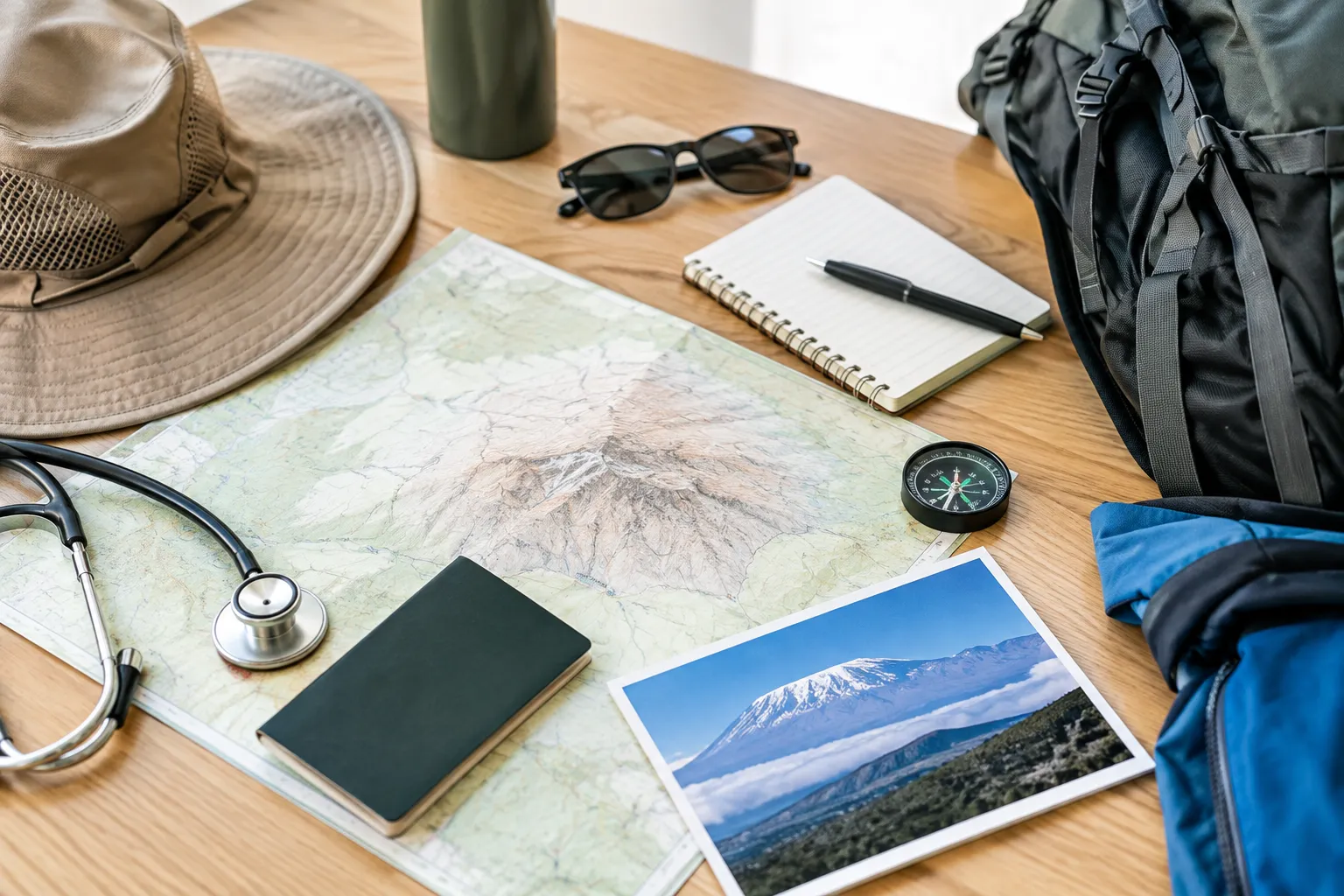
Start with the CDC’s Tanzania destination guidance and read the sections on health, vaccines, and travel precautions. Treat this as research for your appointment rather than a checklist to follow without considering your circumstances. The aim of using CDC Kilimanjaro travel health advice is to identify relevant questions for your specific trip.
Work through these steps:
- Write down where you will go in Tanzania. Include your arrival city, the region where your climb begins and ends, and any time in other parts of the country.
- Add every planned safari destination and side trip. Rural and urban stays, overnight stops, and activities can change which health risks a clinician considers.
- List your international connections and any countries where you will spend time outside the airport. Transit can matter for entry rules, even when Tanzania is the main destination.
- Note your travel dates and how long you expect to be away. Share the full schedule with your clinician, including time before and after the climb.
A search for CDC travel advice for Tanzania or CDC vaccine recommendations for Tanzania can help you locate destination-specific guidance. But the CDC’s recommendations are not all the same as Tanzania’s entry requirements. In particular, “recommended” does not automatically mean “required.”
For a separate overview of entry rules and vaccine considerations, see our guide to Tanzania vaccinations and yellow fever requirements. Recheck the official information close to departure because guidance and entry rules can change.
Book a travel-health appointment early

Arrange a travel-health appointment as soon as your dates and itinerary begin to take shape. Some vaccines involve more than one dose or need time before travel, so an early conversation gives you more room to plan. If your departure is approaching, still ask for an appointment rather than assuming there is no point in going.
Bring or prepare:
- Your route, travel dates, and planned safari or other side trips
- Your flight itinerary, including connections and any extended stopovers
- Your vaccination record, if available
- A list of current medicines, allergies, and relevant health conditions
- Notes about previous vaccine reactions or other concerns you want to discuss
This information helps a clinician interpret CDC Tanzania vaccine advice for your circumstances. A general destination page cannot account for every medical history or activity. Be clear that you are planning a high-altitude trek as well as travel in Tanzania; that can raise questions beyond routine travel vaccines, including how existing health conditions or medicines fit with the climb.
Check routine immunizations before destination-specific vaccines

Ask the clinician to review routine immunizations first. A trip abroad is a practical reason to check whether your usual vaccinations are current, but the right next step depends on your records and health history.
Then discuss destination-specific vaccines and other health precautions listed in the CDC’s Tanzania guidance. Ask the clinician to explain which recommendations apply to your itinerary and why. The answer may differ for two travelers going on the same climb because of differences in age, medical history, previous vaccinations, planned activities, or time spent in different areas.
To make the conversation useful:
- Bring written records rather than relying only on memory.
- Ask which routine vaccinations need attention and whether any follow-up is needed.
- Review destination-specific recommendations against your full itinerary.
- Write down the timing and next steps for any vaccines or medicines discussed.
Avoid treating a search result for “immunizations required for Tanzania” as a complete list of what you personally need. Search wording often combines medical recommendations with border-entry rules, which are separate questions. Your clinician can help interpret the medical side; check official Tanzanian entry information for the rules that apply to your route.
Ask which Tanzania vaccine requirements apply to your route
Use precise questions to distinguish health advice from documentation required for entry. A vaccine can be recommended for health reasons without being a condition of entry, while a certificate rule may depend on travel history rather than your final destination alone.
Ask:
- Which vaccines or preventive measures are recommended for my itinerary?
- Are any vaccinations required for Tanzania entry in my specific circumstances?
- Do my transit countries, stopover length, or recent travel history affect certificate rules?
- Should I carry proof of vaccination or another health document?
- Where should I check the latest official entry requirements before I fly?
If you are unsure whether a yellow fever certificate applies, share every connection with the clinician and check the current entry rules. Do not assume that a short connection is irrelevant—or that every traveler arriving from abroad needs the same document. The details of the route matter.
Our article on who needs yellow fever proof for Tanzania explains the difference between a vaccine recommendation and a proof-of-vaccination requirement. Use it as background, then verify the rule for your own itinerary through official sources.
Turn your clinician’s advice into a pre-climb plan
Before the appointment ends, make sure you understand what to do and when. Ask the clinician to put the plan in writing or make sure you can access it later. Include follow-up appointments, vaccine doses, prescription instructions, and any documents you need to carry.
A simple planning table can keep the moving parts clear:
| Check | What to record |
|---|---|
| Vaccines | What was recommended, what is scheduled, and whether another dose or appointment is needed |
| Medicines | What was prescribed, when to start or stop, and any instructions to follow |
| Documents | Vaccination records, certificates, prescriptions, and other paperwork to carry |
| Follow-up | Who to contact with questions and when to review the plan again |
| Itinerary changes | Whether a new connection, safari stop, or longer stay calls for updated advice |
Ask directly about medicines you may be considering for altitude illness and medicines for travel-related infection prevention. Do not start, combine, or change medication based only on an online discussion. The timing and suitability of a medicine can depend on your health, other prescriptions, and the details of your trip.
Leave time for arrival and sleep before the climb where your itinerary allows. Keep essential medication and health documents accessible during travel rather than packing everything in checked baggage. If flights, connections, or side trips change, revisit the advice rather than assuming your old plan still covers the new itinerary.
Kilimanjaro Health Advice FAQ
What vaccines are recommended for travel to Tanzania by the CDC?
CDC vaccine recommendations for Tanzania depend on the traveler and itinerary; review the destination guidance with a clinician alongside your routine immunization record. Recommendations are not automatically entry requirements.
Is it safe for US citizens to travel to Tanzania right now?
Safety conditions can change, so check current U.S. government travel advisories and health guidance shortly before departure. Consider your itinerary and personal circumstances rather than relying on a general yes-or-no answer.
Does a yellow fever certificate depend on where I connect before Tanzania?
It can: yellow fever certificate rules may depend on your recent travel and route, including certain connections. Check the current entry requirements for your exact itinerary before flying.
Could a safari stop or side trip change the health advice for my Kilimanjaro trip?
Yes. A safari or side trip can change the locations, activities, and exposure considerations a clinician reviews, so include every planned stop when discussing CDC Tanzania guidance.
Can I take altitude-sickness medicine with malaria-prevention medicine?
Sometimes medicines can be used during the same trip, but suitability and potential interactions depend on the specific drugs and your health. Ask your clinician to review the exact medicines before departure.
What should I do if I develop a fever after returning from Tanzania?
Contact a healthcare professional promptly and clearly mention your recent travel to Tanzania. Share where you went and when, even if the fever begins after you have been home for a while.
Can I get travel vaccines in Tanzania if I run out of time before departure?
Do not assume you can complete your plan after arrival; availability, timing, and documentation needs can vary. Contact a travel-health clinician before departure to discuss what is still possible.
Will travel insurance cover the cost of recommended vaccines?
Coverage varies by policy, vaccine, and insurer, and a travel-health visit may be treated differently from routine care. Check your plan documents or ask the insurer before booking.
Confirm your health plan before departure
In the weeks before travel, compare your appointment notes with your final flight itinerary and current official guidance. Confirm that follow-up doses and prescriptions are arranged, and that you know what documents to carry. If a connection, safari stop, or travel date changes, ask whether the change affects the plan.
Keep a copy of your vaccination record and medication details with your travel documents. Make sure someone traveling with you knows how to find essential health information if needed. For broader planning alongside health preparation, you can review our Tanzania travel information and Kilimanjaro planning resources.
A careful health plan does not guarantee a particular outcome on the mountain. It does help you arrive with clear instructions, fewer last-minute questions, and advice matched to the trip you are actually taking.
Sedrick Silayo is a Web Developer and Digital Marketing Expert at Eco-Africa Climbing, with over 10 years of experience in Tanzania’s adventure travel industry. He specializes in Kilimanjaro trekking and Northern Tanzania safaris, sharing practical expertise on trip planning, mountain preparation, safety, KPAP standards, and safari experiences.