Kilimanjaro Trekking Poles for Women: How to Choose and Use Them
Choosing the right Kilimanjaro trekking poles for women can make long hiking days more comfortable and help with balance on both uphill and downhill sections.
Trekking poles are not compulsory for every climber, but many women find them useful on Kilimanjaro because the route includes long climbs, uneven ground, steep sections, and significant descending.
The most important thing is not simply owning trekking poles. You should know how to adjust and use them before arriving in Tanzania.
Why Use Trekking Poles on Kilimanjaro?
Trekking poles can provide several practical benefits.
- Additional balance.
- More stability on uneven ground.
- Support during long descents.
- A more rhythmic walking pattern.
- Extra confidence on loose or rocky terrain.
- Support when legs are tired.
Do Women Need Trekking Poles for Kilimanjaro?
Not every climber uses poles in exactly the same way.
However, they can be particularly useful for women who:
- Are new to mountain hiking.
- Want extra stability.
- Are concerned about long descents.
- Have limited experience on uneven trails.
- Prefer additional support when tired.
Are Trekking Poles Only for Older Climbers?
No.
Trekking poles are used by hikers of many ages and fitness levels.
A young, fit climber may use them simply because they improve balance or make long descents feel more controlled.
Do Women Need Women-Specific Trekking Poles?
Not necessarily.
Some poles are marketed specifically for women and may include:
- Shorter adjustment ranges.
- Smaller grips.
- Lighter construction.
However, the most important factors are comfort, correct length, grip size, strength, and ease of adjustment.
What Type of Trekking Poles Are Best?
Look for poles that are:
- Adjustable.
- Comfortable to grip.
- Strong enough for trekking.
- Easy to shorten and extend.
- Compact enough for travel.
Adjustable vs Fixed-Length Poles
Adjustable poles are especially practical for Kilimanjaro because you can change their length depending on terrain.
You may prefer different lengths for:
- Flat walking.
- Uphill climbing.
- Downhill trekking.
Telescoping Trekking Poles
Telescoping poles use sections that slide inside each other.
They are common because they can be adjusted easily and packed smaller for travel.
Folding Trekking Poles
Folding poles collapse into several connected sections.
They can pack very compactly and may be useful for travelers with limited luggage space.
Which Is Better: Folding or Telescoping?
Both can work well.
Choose based on:
- Adjustment range.
- Strength.
- Packability.
- Ease of use.
- Personal preference.
Trekking Pole Material
Common pole materials include aluminum and carbon-based constructions.
Each has different trade-offs in:
- Weight.
- Durability.
- Flexibility.
- Cost.
For Kilimanjaro, reliability and comfort are more important than choosing poles based only on the lightest possible weight.
How Long Should Trekking Poles Be?
Correct pole length depends partly on your height and the terrain.
On relatively flat ground, a common starting point is having the elbow bent at roughly a right angle when holding the grip naturally.
Shorter Poles for Uphill Sections
On steep uphill terrain, many hikers shorten their poles slightly.
This can make placement feel more natural as the ground rises in front of you.
Longer Poles for Descents
On downhill sections, poles can sometimes be lengthened slightly to provide support farther in front of the body.
Use small adjustments rather than dramatic changes.
Do Not Copy Someone Else’s Pole Length
Two women of similar height may still prefer slightly different settings.
Use your own comfort and movement as the guide.
Grip Size Matters
Women with smaller hands may find a narrower grip more comfortable.
The grip should feel secure without forcing your hand into an awkward position.
Common Grip Materials
Trekking pole grips may use materials such as:
- Foam.
- Cork.
- Rubber or synthetic materials.
Which Grip Is Best?
There is no single best option.
Choose the one that feels comfortable during longer use, especially when your hands are warm, cold, or wearing gloves.
Extended Grip Sections
Some poles include extra grip material below the main handle.
This can be useful on short steep sections because you can move your hand lower without changing the pole length.
How to Use Trekking Pole Straps
Pole straps can help you maintain control of the poles and reduce the need to squeeze the grip tightly.
Practice correct strap use during training.
Do Not Grip the Pole Too Tightly
A constantly tight grip can create unnecessary hand and forearm fatigue.
Aim for a relaxed but controlled grip.
Practice With Gloves
Your trekking poles may feel very different when you are wearing warm gloves.
Before Tanzania, check:
- Whether your hands fit comfortably through the straps.
- Whether you can grip the handles securely.
- Whether you can operate the adjustment mechanism.
How to Walk With Trekking Poles
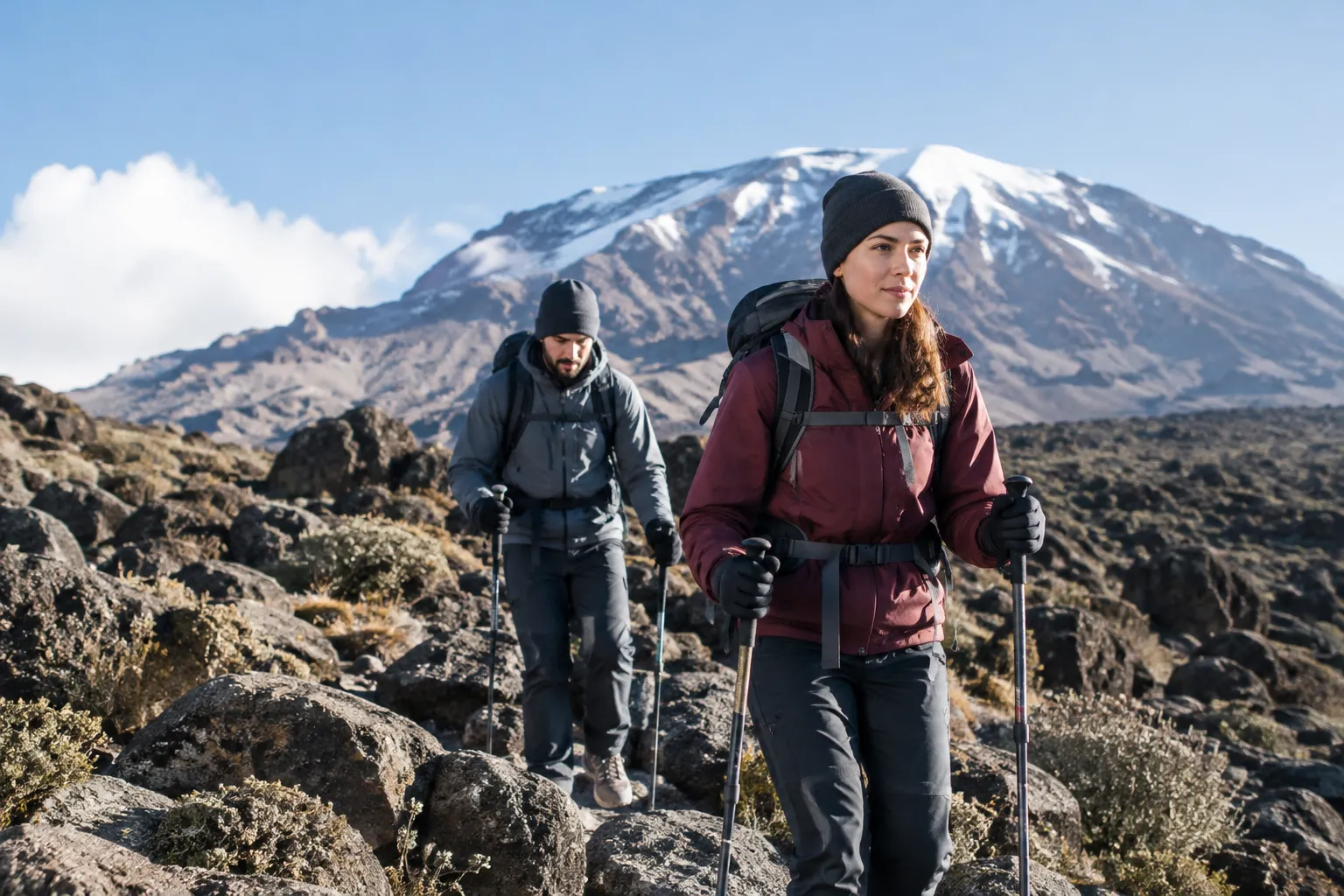
A natural walking pattern usually develops when the poles move opposite the legs.
For example:
- Right foot forward, left pole forward.
- Left foot forward, right pole forward.
You do not need to overthink every step once the movement becomes natural.
Do Not Plant the Poles Too Far Ahead
Reaching too far forward can disturb your posture and rhythm.
Keep pole placement controlled and relatively close to your natural stride.
Trekking Poles on Flat Terrain
On flatter sections, use a relaxed alternating rhythm.
You may not need to place much body weight onto the poles.
Trekking Poles Uphill
On uphill terrain, poles can help with rhythm and stability.
For steeper climbing, some hikers use both poles more deliberately to support forward movement.
Do Not Pull Yourself Up Entirely With Your Arms
Your legs should still do the main work.
Poles are support tools, not a substitute for leg strength.
Trekking Poles Downhill
Many climbers appreciate poles most during long descents.
They can provide extra points of contact with the ground and help with balance.
Place the Pole Before Committing Your Weight
On uneven downhill terrain, plant the pole securely before relying on it.
Avoid placing your full weight onto an uncertain or unstable pole placement.
Do Not Reach Too Far Downhill
Overreaching can pull your upper body forward and reduce balance.
Use controlled placements.
Why Descents Matter on Kilimanjaro
After reaching the summit, the journey continues downhill.
Descending can be demanding on:
- Quadriceps.
- Knees.
- Ankles.
- Feet.
Poles can help some climbers feel more controlled on these sections.
Trekking Poles and Knee Comfort
Some hikers find poles helpful because they provide additional support during descents.
However, poles are not a treatment for a knee injury.
Persistent knee pain should be addressed before the climb.
Trekking Poles and Balance
Poles can create two additional points of contact with the ground.
This may improve confidence on:
- Loose ground.
- Rocky trails.
- Muddy sections.
- Uneven surfaces.
Do Poles Replace Good Balance?
No.
You should still develop basic balance through hiking and strength training.
Using Poles in Mud
Lower sections of the mountain can sometimes be wet or muddy.
Use poles carefully because the tip can also slip or sink into soft ground.
Using Poles on Rocks
Pole tips can behave differently on hard rock than on soil.
Avoid assuming every placement will grip perfectly.
Trekking Pole Tips
Many poles use durable pointed tips designed for hiking surfaces.
Some systems also include removable rubber tip protectors for certain surfaces or transport.
Do You Need Snow Baskets?
Pole baskets can help prevent the pole from sinking too deeply into softer terrain.
Use the components appropriate to the actual route and conditions.
Anti-Shock Trekking Poles
Some trekking poles include internal shock-absorbing systems.
Some hikers like this feature, while others prefer a more direct and rigid pole feel.
It is mainly a personal preference.
Do You Need Lightweight Poles?
Lighter poles can reduce arm fatigue, but weight is not the only factor.
Also consider:
- Durability.
- Grip comfort.
- Locking reliability.
- Adjustment range.
The Locking Mechanism Matters
Adjustable poles usually use a locking system to hold the selected length.
Your poles should remain secure under normal trekking use.
Test Pole Locks Before Tanzania
Check that:
- The sections do not collapse unexpectedly.
- The adjustment system is easy to operate.
- You know how to tighten or reset it.
Do Not Wait Until Summit Night to Learn the Mechanism
Cold hands and darkness are not ideal conditions for learning how your equipment works.
Train With Your Trekking Poles
Your first experience with trekking poles should not be on Kilimanjaro.
Use them during:
- Long walks.
- Hill training.
- Downhill hiking.
- Back-to-back hiking weekends.
Why Training Matters
Using poles involves coordination.
At first, they may feel awkward.
After enough practice, they should become part of your natural walking rhythm.
Practice Adjusting Length Quickly
During training, practice changing pole length so you understand the mechanism without needing instructions each time.
Practice Folding or Collapsing Them
You will not always want to use your poles.
Learn how to collapse them efficiently and attach them to your backpack.
Attaching Poles to Your Daypack
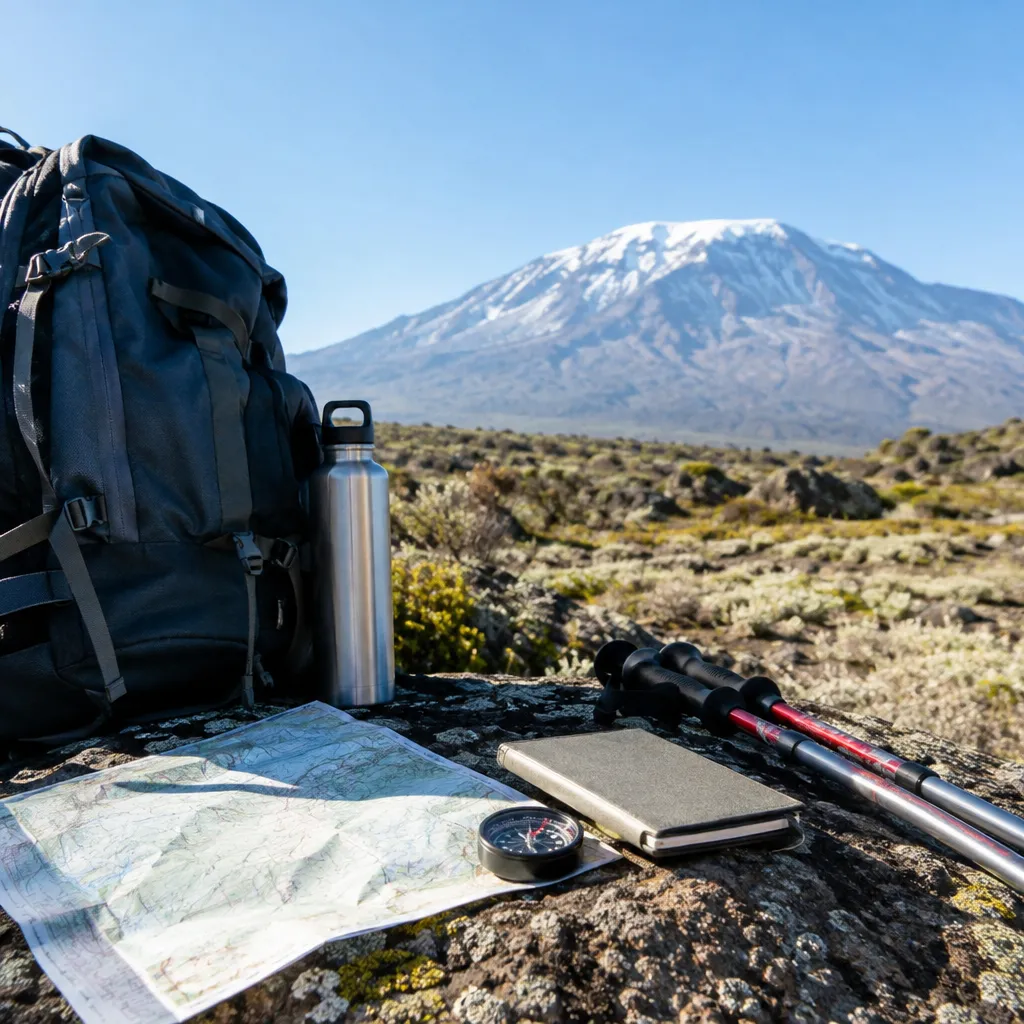
Many hiking backpacks include trekking pole attachment points.
Practice securing your poles before travel.
Keep Attached Poles Stable
They should not swing loosely, interfere with other hikers, or catch easily on surrounding objects.
Do You Need Poles on Barranco Wall?
Barranco Wall involves controlled scrambling where you may need your hands for balance and movement.
Your guide may advise when to use or store poles depending on the exact section and conditions.
Why Pack Attachment Matters at Barranco Wall
If you need your hands free, you should be able to secure the poles properly to your backpack.
Trekking Poles on Summit Night
Many climbers use poles during summit night because they can help with:
- Rhythm.
- Balance.
- Stability when tired.
- The later descent.
Practice With Thick Gloves Before Summit Night
Make sure you can comfortably grip the handles and use the straps while wearing the gloves you plan to use in cold conditions.
Do Not Depend Completely on the Poles
Even on summit night, your poles should support your movement rather than become the only thing keeping you upright.
Trekking Poles and the Summit Descent
The descent after the summit can be tiring because your legs have already completed the ascent.
Poles can provide additional stability when fatigue is high.
Women With Smaller Hands
Look for a grip that does not feel overly thick.
You should be able to hold it comfortably without excessive tension in your hand.
Women With Wrist Problems
If you have an existing wrist or hand condition, test poles carefully and seek appropriate professional advice if needed.
Women With Shoulder Problems
Pole use creates repeated arm and shoulder movement.
If you have persistent shoulder issues, consider them during training rather than discovering discomfort on the mountain.
Women Over 40, 50 and 60
Trekking poles can be useful at any age.
Women who value additional balance or support during descents may find them especially helpful.
Age itself does not determine whether you need poles.
Trekking Poles During Your Period
Your pole technique does not need to change during menstruation.
However, if you are feeling more fatigued than usual, poles may simply provide additional stability during the day.
Trekking Poles During Perimenopause
If fatigue or balance confidence varies from day to day, having familiar poles available can provide another support option.
Should Beginners Use Trekking Poles?
Yes, beginners can use them.
In fact, learning during training can help first-time hikers feel more confident on uneven terrain.
Do Experienced Hikers Need Them?
Many experienced hikers still use poles because they value rhythm and stability.
Experience does not make them unnecessary.
Can You Use Only One Trekking Pole?
Some hikers occasionally use one pole, but using a pair provides more symmetrical support and additional points of contact.
For most long trekking situations, a pair is the more common setup.
Common Mistake: Buying Poles and Never Practicing
Do not arrive in Tanzania with poles still inside their original packaging.
Common Mistake: Incorrect Pole Length
Poles that are much too long or too short can create awkward posture and movement.
Common Mistake: Gripping Too Hard
A tight grip throughout the day can create unnecessary forearm fatigue.
Common Mistake: Leaning Too Much on the Poles
Poles should assist movement, not replace your ability to support yourself through your legs.
Common Mistake: Placing Poles Too Far Ahead
Overreaching can disrupt balance, especially on descents.
Common Mistake: Ignoring the Locking System
Check that your poles stay securely adjusted.
A pole that collapses unexpectedly can create a dangerous loss of support.
Common Mistake: Not Testing Poles With Gloves
Cold-weather gloves can change how the grips and straps feel.
Common Mistake: Carrying Broken or Worn Poles
Inspect your poles before travel.
Check:
- Locks.
- Tips.
- Straps.
- Shafts.
- Connections.
Packing Trekking Poles for International Travel
Airline rules can vary, so confirm current baggage requirements before departure.
Collapse or fold the poles and protect the tips so they do not damage other luggage.
Do Not Assume They Can Go in Cabin Baggage
Check your airline’s current rules because trekking poles may be subject to baggage restrictions.
Keep Pole Parts Together
If your poles have removable baskets or accessories, organize them carefully so small parts are not lost during travel.
Can Trekking Poles Be Rented?
Trekking poles may be available as rental equipment, but current availability should be confirmed before your trip.
If you prefer to bring your own, train with the exact pair before Tanzania.
Own Poles vs Rental Poles
Your own poles give you time to learn the grip, straps, adjustments, and locking system before travel.
Rental poles can be practical for travelers who do not want to buy equipment they may use only occasionally.
How to Know Your Poles Are Ready for Kilimanjaro
Before departure, you should be able to:
- Adjust the length without assistance.
- Use the straps correctly.
- Walk naturally with both poles.
- Use them uphill.
- Use them downhill.
- Secure them to your backpack.
- Use them while wearing gloves.
Simple Trekking Pole Checklist
| Feature | What to Check |
|---|---|
| Length | Adjusts comfortably to your height and terrain |
| Grip | Comfortable for your hand size |
| Straps | Comfortable and easy to adjust |
| Locks | Remain secure under normal pressure |
| Tips | Not excessively worn or damaged |
| Packability | Easy to collapse and attach to your daypack |
Why Trekking Poles Fit the 7-Day Machame Route
WomenClimbKili scheduled departures use the 7-day Machame Route.
Across several trekking days, you encounter changing terrain, repeated elevation gain, uneven surfaces, Barranco Wall, summit night, and the later descent.
Trekking poles can provide useful additional stability across many of those stages.
View the full itinerary on our Women-Only Machame Route Kilimanjaro Package .
Can Solo Female Travelers Use Trekking Poles?
Absolutely.
Pole use is based on personal comfort and trekking needs, not whether you are traveling alone or with friends.
Solo female travelers are welcome to reserve individual places on scheduled WomenClimbKili departures.
Frequently Asked Questions
Do women need trekking poles for Kilimanjaro?
They are not compulsory for every woman, but many climbers find them useful for stability, uphill rhythm, and long descents.
Do I need two trekking poles?
A pair is commonly used because it provides support on both sides and allows a natural alternating walking rhythm.
How should trekking poles be sized?
A useful starting point on flat ground is a natural grip position with the elbow around a right angle. Adjust slightly for uphill and downhill terrain as needed.
Should trekking poles be shorter uphill?
Many hikers shorten them slightly for steep uphill sections so the grips remain comfortable as the terrain rises.
Should poles be longer downhill?
Slightly longer poles can sometimes provide more comfortable support on descents, depending on terrain and personal preference.
Are trekking poles useful on summit night?
Yes. Many climbers find them useful for rhythm, balance, and stability during the long summit ascent and descent.
Can I use poles on Barranco Wall?
Some sections may require your hands for scrambling, so your guide may advise you to secure the poles to your backpack where appropriate.
Should I practice with poles before Tanzania?
Yes. Train with them on flat ground, hills, and descents so the movement and adjustments feel familiar before the climb.
Can trekking poles prevent altitude sickness?
No. Trekking poles can support balance and walking efficiency, but they do not affect how your body acclimatizes to altitude.
The Best Trekking Poles Are the Ones You Know How to Use
A good pair of trekking poles can become one of your most useful pieces of Kilimanjaro equipment.
But buying them is only the first step.
Adjust them to your height. Practice your walking rhythm. Learn how to use the straps. Train uphill and downhill. Test them while wearing gloves. Learn how to collapse and attach them to your daypack.
By the time you arrive in Tanzania, the poles should feel like a natural extension of your walking rather than unfamiliar equipment.
Explore our WomenClimbKili scheduled departures or view the complete 7-Day Women-Only Machame Route Package .
Share:

Social Media
Most Popular
Machame Route Pacing for Women | How Slow Should You Walk?
Machame Route Terrain for Women | Trail & Walking Conditions Guide
Machame Route Camps for Women | What to Expect Each Night
Kilimanjaro Descent for Women | What to Expect After Summit
Book Your Sustainable Tour
Related Posts
Machame Route Pacing for Women | How Slow Should You Walk?
Machame Route Pacing for Women: How Slow Should You Walk? Understanding Machame Route pacing for women can be just as important as building fitness before
Machame Route Terrain for Women | Trail & Walking Conditions Guide
Machame Route Terrain for Women: What the Trail Is Really Like Understanding the Machame Route terrain for women can help you train more intelligently and
Machame Route Camps for Women | What to Expect Each Night
Machame Route Camps for Women: What to Expect Each Night Understanding the Machame Route camps for women can make the idea of spending several nights
Kilimanjaro Descent for Women | What to Expect After Summit
Kilimanjaro Descent for Women: What to Expect After the Summit The Kilimanjaro descent for women is one of the most underestimated parts of the entire