Stella Point to Uhuru Peak for Women: The Final Kilimanjaro Push
Reaching Stella Point is one of the biggest moments of the Machame Route, but the journey is not finished yet.
For women climbing via Machame, the section from Stella Point to Uhuru Peak is the final part of the summit journey.
By this stage, you have already climbed through the night, reached the crater rim, managed cold conditions, high altitude, tired legs and many hours of slow upward movement.
Then comes the final question:
Can you continue from Stella Point to Uhuru Peak?
For many climbers, this final section is less steep than the ascent to Stella Point, but because of the extreme altitude and accumulated fatigue, it can still feel surprisingly difficult.
What Is Stella Point?
Stella Point is one of the crater-rim points on Mount Kilimanjaro.
Climbers using routes such as Machame, Lemosho and Umbwe normally reach the crater rim here before continuing toward Uhuru Peak.
Is Stella Point the Summit?
Stella Point is a major summit milestone, but Uhuru Peak is the highest point of Mount Kilimanjaro.
If conditions and your health allow, the journey continues along the crater rim toward Uhuru Peak.
Why Stella Point Feels So Emotional
By the time you arrive at Stella Point, you may have been walking for several hours in darkness.
Many women arrive feeling a mixture of:
- Relief.
- Exhaustion.
- Excitement.
- Emotion.
- Disbelief.
- Determination.
You Have Already Completed the Steepest Part
The long climb from high camp to the crater rim is one of the most physically demanding parts of the summit attempt.
Once you reach Stella Point, the route toward Uhuru Peak is generally more gradual.
Why Can the Final Section Still Feel Hard?
Because you are extremely high on the mountain.
Even gradual walking can feel difficult when:
- Your legs are tired.
- You have been walking for hours.
- The air is thin.
- You are cold.
- Your appetite may be low.
- You still need to concentrate on every step.
Altitude Changes the Meaning of “Easy”
A relatively gentle walking section at low altitude may feel simple.
At very high elevation, that same type of terrain can feel much more demanding.
Do Not Expect to Suddenly Feel Strong at Stella Point
Reaching the crater rim is a major achievement, but your body does not automatically recover the moment you arrive.
You are still at very high altitude.
The Final Push Is About Patience
The best mindset is not:
“I am almost there, so I must go fast.”
Instead:
“I will keep moving slowly and consistently until I reach Uhuru Peak.”
How Far Is Uhuru Peak From Stella Point?
The remaining distance may not look very long on a map, but distance alone does not describe how the final section feels.
At this altitude, every step requires patience.
Avoid Obsessing Over Minutes and Distance
Asking constantly how much farther remains can make the final stage feel longer.
Focus instead on:
- Your breathing.
- Your pace.
- Your guide.
- The next few metres.
What Does the Route Look Like?
From Stella Point, climbers move along the crater rim toward Uhuru Peak.
The terrain is generally less steep than the ascent leading to Stella Point.
However, conditions may include:
- Cold.
- Wind.
- Snow or ice depending on conditions.
- High-altitude exposure.
Do You Need Technical Climbing Skills?
No technical mountaineering skills are normally required on the standard Machame summit route.
The main challenge is walking at very high altitude.
Do Women Need Special Strength for This Section?
No.
You need endurance, patience and enough remaining energy rather than exceptional upper-body strength.
Can Beginners Reach Uhuru Peak?
Yes, first-time climbers can reach Uhuru Peak if they are appropriately prepared and their health and altitude response allow them to continue.
Does Reaching Stella Point Mean You Will Definitely Reach Uhuru?
No.
Although you are close, your guide still needs to consider:
- Your symptoms.
- Your energy.
- Your coordination.
- Your overall condition.
- Mountain conditions.
Health Comes Before the Final Photo
Uhuru Peak is an important goal, but it is not more important than your safety.
If your guide determines that continuing is not appropriate, follow that advice.
Do Not Hide Symptoms Because Uhuru Is Close
Some climbers are tempted to ignore how they feel once they realize the summit is nearby.
This is not the time to stop communicating honestly.
What Might You Feel at Stella Point?
Experiences vary, but you may notice:
- Heavy fatigue.
- Cold hands or feet.
- Low appetite.
- Breathlessness.
- Headache.
- Strong emotion.
Not Every Woman Feels the Same
One woman may feel surprisingly strong while another needs more time.
Do not compare yourself with the person next to you.
Fitness Does Not Fully Predict Summit Experience
A very fit runner can still struggle with altitude.
A slower recreational hiker may feel comparatively well.
Altitude response is individual.
The Importance of Slow Walking
Continue using the same slow, controlled approach that brought you through the night.
There is no prize for reaching Uhuru Peak several minutes earlier.
Do Not Sprint the Final Section
Feeling excited at Stella Point can make you want to move faster.
Save your energy and maintain the pace set by your guide.
Breathing at the Crater Rim
Your breathing may feel noticeably harder than at lower elevation.
Use steady breathing and avoid unnecessary bursts of effort.
Why Short Stops Can Feel Cold
When you stop walking, your body produces less heat.
Keep your warm clothing correctly adjusted during pauses.
Gloves Should Stay On
Avoid repeatedly exposing bare hands in cold conditions just to take photos or adjust small items.
Use Liner Gloves for Small Tasks
Thin liner gloves can help if you need more dexterity while keeping some hand protection.
Warm Feet Matter
By this stage, your feet have been inside boots for many hours.
Cold toes can make the final section feel much more difficult.
Do Not Overtighten Boots
Boots need to feel secure but not painfully restrictive.
Trekking Poles on the Final Push
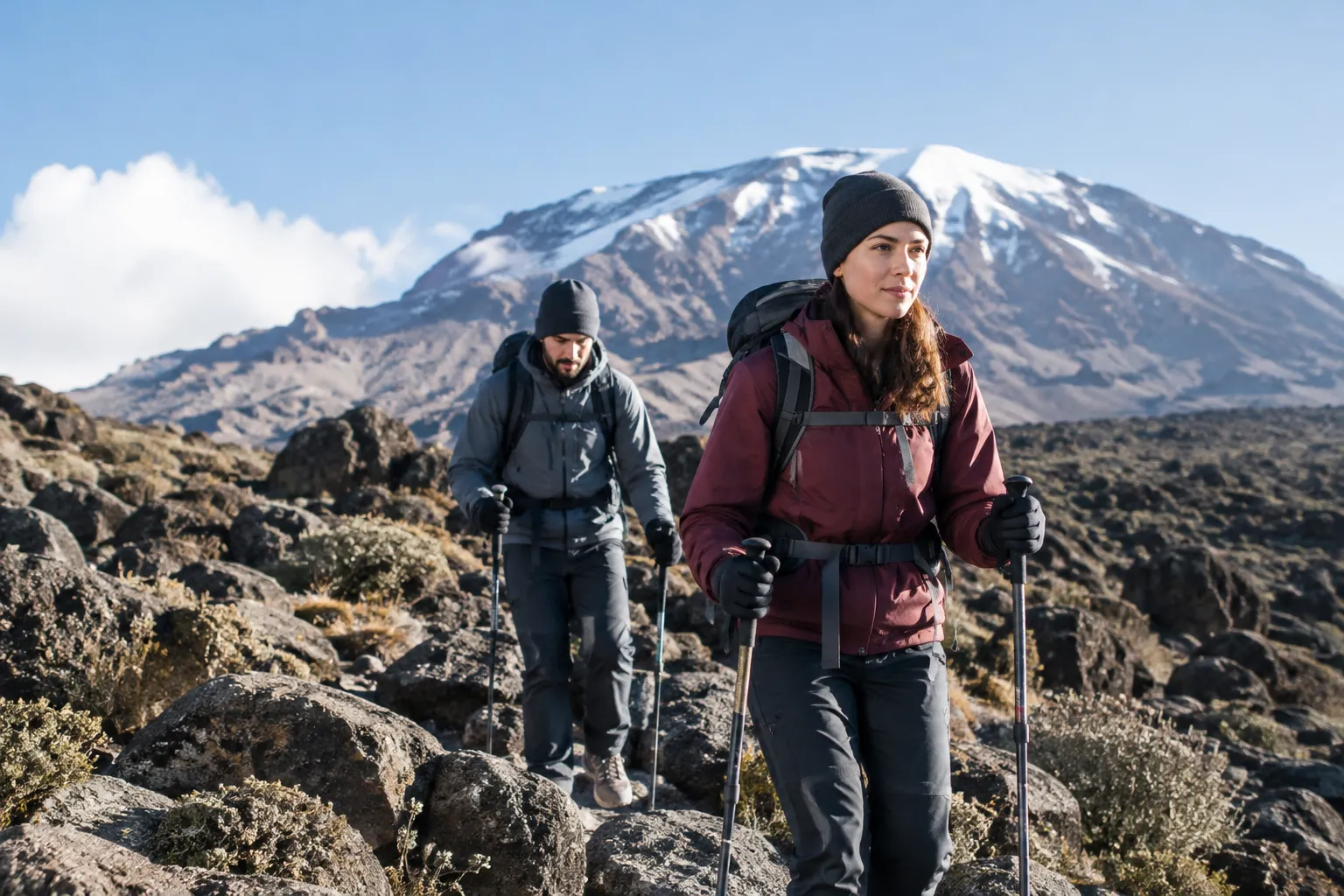
Many women continue using trekking poles from Stella Point toward Uhuru Peak.
Poles can help with:
- Balance.
- Rhythm.
- Stability when tired.
Do Not Lean Completely on the Poles
Your legs should still support your movement.
Headlamp After Stella Point
Depending on when you reach the crater rim, it may still be dark or dawn may be beginning.
Keep your headlamp in use until natural light is sufficient.
Turn Off the Headlamp When You No Longer Need It
Once daylight is strong enough, switch it off and secure it.
Sunrise Can Change the Experience
For many climbers, sunrise brings a psychological boost after hours of darkness.
The landscape becomes visible and Uhuru Peak can feel more real.
But Sunrise Does Not Remove Altitude
You may feel emotionally stronger while your body is still working at very high elevation.
Continue slowly.
Sunglasses After Sunrise
Once daylight becomes strong, sunglasses become important.
Keep Sunglasses Accessible
Do not bury them at the bottom of your daypack.
Sun Protection
Use appropriate sun protection once the sun rises.
This can include:
- Sunglasses.
- Sunscreen.
- Lip protection.
Water on the Final Section
Continue drinking according to your needs and your guide’s advice.
Do Not Stop Drinking Because the Summit Is Close
You still have the final push and a long descent afterward.
Snacks at High Altitude
Some women have very little appetite by this stage.
Small familiar snacks may be easier to manage.
Do Not Force Complicated Food
Keep summit snacks simple and easy to handle.
Why Familiar Snacks Matter
You already know how your stomach responds to them.
Mental Fatigue Can Be Strong
You may physically be able to continue but mentally feel that you have had enough.
Use Small Goals
Do not think:
“I still need to walk all the way to Uhuru.”
Think:
- Stay with the pace.
- Take the next ten steps.
- Reach the next visible section.
- Continue steadily.
Do Not Constantly Look for the Summit Sign
The final stretch can feel longer if you are continuously searching for the end.
Trust the Process
Your guide knows the route.
Continue moving at the appropriate pace.
Can Women Cry at Stella Point?
Of course.
Strong emotion is common during major endurance experiences.
Some climbers cry from:
- Relief.
- Exhaustion.
- Happiness.
- Pride.
- The intensity of the moment.
Emotion Is Not a Sign You Cannot Continue
Take a moment, breathe, and follow your guide.
What If You Feel Like Giving Up?
Tell your guide how you feel.
There is a difference between:
- Normal mental fatigue.
- Physical exhaustion.
- Concerning altitude symptoms.
Your Guide Helps Make That Distinction
Do not make important health decisions based only on determination or disappointment.
Women During Their Period
Menstruation does not automatically prevent you from continuing from Stella Point to Uhuru Peak.
However, individual symptoms can affect comfort and energy.
Keep Hygiene Supplies Accessible
Anything you may need during the summit day should be in your daypack rather than inaccessible luggage.
Heavy Bleeding and Fatigue
If you have known anemia, iron deficiency or unusually heavy menstrual bleeding, discuss high-altitude trekking with an appropriate healthcare professional before travel.
Perimenopause and the Final Summit Push
Some women experience changes in temperature comfort, sleep or energy during perimenopause.
Flexible clothing layers can help with temperature management.
Women Over 40
Women over 40 can reach Uhuru Peak depending on individual health, fitness, acclimatization and preparation.
Women Over 50
Age alone does not determine summit ability.
A well-prepared woman over 50 may perform extremely well.
Women Over 60
Women over 60 can also attempt the Machame Route when their health, fitness and individual medical circumstances are appropriate.
Do Younger Women Automatically Have an Advantage?
Not necessarily.
Endurance, pacing, health, preparation and altitude response matter more than age alone.
Approaching Uhuru Peak
As you get closer to Uhuru Peak, the emotional intensity can increase.
You may begin seeing more climbers returning from the summit.
Do Not Let Returning Climbers Change Your Pace
They are on a different stage of their journey.
Continue at your own group’s pace.
The Uhuru Peak Sign
Seeing the summit sign can be an unforgettable moment after several days of trekking.
Take Your Time With the Moment
Celebrate, take photos and appreciate the achievement, while continuing to follow your guide’s instructions.
Do You Stay at Uhuru Peak for a Long Time?
Time at very high altitude is normally limited.
Your guide will determine the appropriate timing based on conditions and the group.
The Summit Is Not the End
This is one of the most important things to remember.
After reaching Uhuru Peak, you still need to descend.
Why Descending Matters
You are still at extreme elevation.
Descending takes you back toward lower altitude and continues the physical work of summit day.
Do Not Use All Your Energy for Summit Photos
Save concentration and energy for the descent.
The Return Toward Stella Point
After Uhuru Peak, climbers return along the crater rim toward the descent route.
Descending Can Feel Mentally Easier
You are no longer trying to gain altitude, and the summit goal has been reached.
But Your Legs May Be Very Tired
Fatigue can become more noticeable as you descend.
Why Downhill Training Matters
The descent places repeated demand on:
- Quadriceps.
- Knees.
- Ankles.
- Feet.
Trekking Poles During the Descent
Many women find trekking poles particularly helpful once they begin descending.
Do Not Rush Because You Want Lower Altitude
Move carefully and follow your guide.
Why Uhuru Peak Is Not the Only Measure of Success
Reaching Uhuru Peak is the goal of the climb, but mountain safety requires flexibility.
If health or altitude conditions require you to stop earlier, making the safe decision remains important.
Stella Point Is Already a Major Achievement
A climber who reaches Stella Point has completed a demanding high-altitude ascent.
Never Hide Illness to Reach a Sign
No summit photograph is worth putting your health at unnecessary risk.
How Training Helps the Final Push
Good preparation gives you:
- Walking endurance.
- Leg strength.
- Confidence with long days.
- Experience moving while tired.
What Training Cannot Guarantee
Training cannot guarantee that altitude will affect you in a particular way.
Back-to-Back Hiking Is Valuable
By summit day, you are already carrying fatigue from previous trekking days.
Consecutive-day training helps prepare you for that feeling.
Long Hiking Days Matter
Summit day rewards women who have practiced being on their feet for extended periods.
Mental Training Matters Too
During training, practice continuing calmly when:
- You feel tired.
- The weather is imperfect.
- The hike feels repetitive.
- You still have distance remaining.
Do Not Train by Exhausting Yourself Every Session
Consistency is more valuable than repeatedly destroying yourself in training.
A Simple Stella-to-Uhuru Mindset
| Challenge | Best Response |
|---|---|
| Extreme fatigue | Slow down and stay with the guide’s pace |
| Cold | Keep warm layers and gloves correctly adjusted |
| Low appetite | Use simple familiar snacks where practical |
| Mental fatigue | Focus on short sections rather than the whole distance |
| Concerning symptoms | Tell your guide immediately |
| Excitement near the summit | Do not suddenly increase your pace |
Where This Fits in the 7-Day Machame Route
WomenClimbKili scheduled departures use the 7-day Machame Route.
The route builds toward summit night after several days of trekking and acclimatization.
Machame climbers normally reach Stella Point before continuing along the crater rim toward Uhuru Peak.
View the complete route on our Women-Only 7-Day Machame Route Kilimanjaro Package .
Solo Women and the Summit Experience
You do not need to arrive with your own climbing partner.
Solo female travelers can join scheduled WomenClimbKili departures and share the Machame journey with other women.
Maximum Scheduled Group Size
WomenClimbKili scheduled groups have a maximum of 12 women.
Frequently Asked Questions
Is Stella Point the top of Kilimanjaro?
Stella Point is a major crater-rim point, but Uhuru Peak is the highest point of Mount Kilimanjaro.
Is Stella Point to Uhuru Peak difficult?
The terrain is generally more gradual than the ascent to Stella Point, but extreme altitude and accumulated fatigue can make the final section feel very demanding.
Do women need technical climbing skills?
No. The standard route from Stella Point toward Uhuru Peak is trekking rather than technical rock or ice climbing.
Can first-time female climbers reach Uhuru Peak?
Yes, provided their preparation, health, altitude response and mountain conditions allow them to continue safely.
Should I walk faster after Stella Point?
No. Continue using a slow and controlled pace even though the summit is close.
What if I feel sick at Stella Point?
Tell your guide immediately. Do not hide concerning symptoms simply because Uhuru Peak is nearby.
Do I still need water and snacks after Stella Point?
Yes. You still need to complete the final summit section and descend afterward, so keep appropriate water and simple snacks accessible.
Why do I need sunglasses if summit night starts in darkness?
The final summit section and descent may continue after sunrise, when eye protection becomes important.
Is the climb finished when I reach Uhuru Peak?
No. You still need to descend safely from the summit and continue toward lower camp.
The Final Push Is Still One Step at a Time
Reaching Stella Point can make Uhuru Peak feel incredibly close.
But high altitude changes the meaning of distance.
The final section may be more gradual, yet your tired legs, the cold and the thin air can make every step important.
Do not rush.
Keep your gloves on. Use your trekking poles. Drink appropriately. Take a small snack if you can. Tell your guide honestly how you feel.
Most importantly, do not think about hundreds of remaining steps.
Take the next one.
Then the next.
And if your health and mountain conditions allow, those small steps eventually bring you from Stella Point to the roof of Africa at Uhuru Peak.
Explore our WomenClimbKili scheduled departures or view the complete Women-Only 7-Day Machame Route Kilimanjaro Package .
Share:

Social Media
Most Popular
Machame Route Pacing for Women | How Slow Should You Walk?
Machame Route Terrain for Women | Trail & Walking Conditions Guide
Machame Route Camps for Women | What to Expect Each Night
Kilimanjaro Descent for Women | What to Expect After Summit
Book Your Sustainable Tour
Related Posts
Machame Route Pacing for Women | How Slow Should You Walk?
Machame Route Pacing for Women: How Slow Should You Walk? Understanding Machame Route pacing for women can be just as important as building fitness before
Machame Route Terrain for Women | Trail & Walking Conditions Guide
Machame Route Terrain for Women: What the Trail Is Really Like Understanding the Machame Route terrain for women can help you train more intelligently and
Machame Route Camps for Women | What to Expect Each Night
Machame Route Camps for Women: What to Expect Each Night Understanding the Machame Route camps for women can make the idea of spending several nights
Kilimanjaro Descent for Women | What to Expect After Summit
Kilimanjaro Descent for Women: What to Expect After the Summit The Kilimanjaro descent for women is one of the most underestimated parts of the entire